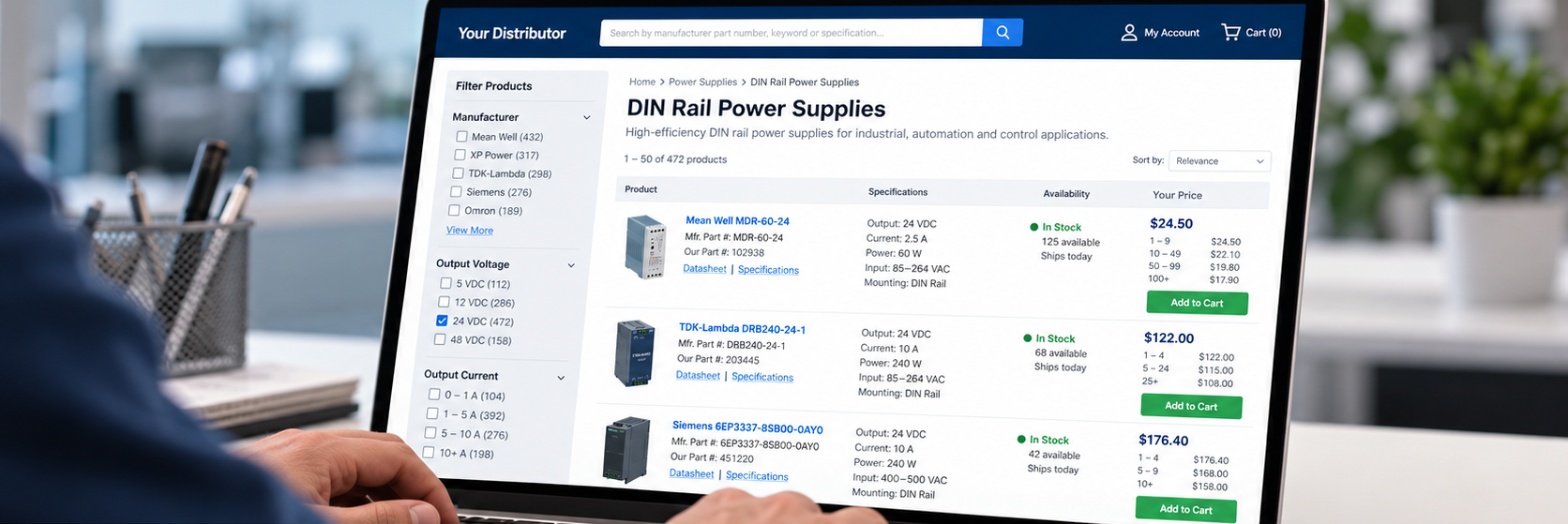
A practical guide to choosing distributor e-commerce software that improves product discovery, simplifies purchasing, connects business systems and turns large product catalogs into online sales opportunities.
For distributors of electronic components, electrical supplies, industrial automation equipment and other technical products, these requirements are particularly demanding. A single catalog may contain hundreds of thousands of manufacturer part numbers, each with unique specifications, documentation, packaging requirements, pricing and availability.
Traditional retail e-commerce software was not necessarily designed for this complexity. A successful distributor e-commerce platform must serve engineers looking for specific components, purchasing departments comparing suppliers, contractors checking availability and established B2B customers placing repeat orders.
Here are 12 essential capabilities distributors should evaluate when selecting or upgrading their e-commerce software.
1. High-Performance E-Commerce for Large Distributor Catalogs
A distributor website with 500 products operates very differently from one with 500,000 products. Large catalogs contain complicated category structures, technical specifications, manufacturer relationships, multiple price levels and frequently changing inventory. Managing this information can introduce significant database and website performance challenges.
A distributor e-commerce platform should deliver fast product pages, category listings and search results without forcing visitors to download oversized pages or unnecessary scripts. Performance should be evaluated using Google PageSpeed Insights and Core Web Vitals, especially on mobile devices. Testing should include actual category and product pages rather than only the homepage.
The DistyMan B2B e-commerce platform is engineered for large technical catalogs, with lightweight pages and a performance objective of sub-500-millisecond page loads. Actual performance depends on deployment, integrations, content and configuration.
What to evaluate: How quickly does the platform display a complex product category containing thousands of parts, filters and specifications?
2. Advanced Product Search and Part Number Lookup
Distributor customers frequently arrive knowing exactly what they need. Their search may start with a manufacturer part number, a partial part number, a description or a specific technical requirement.
A search engine designed primarily for consumer merchandise may struggle with complex industrial part numbering. Effective distributor e-commerce search should recognize exact and partial manufacturer part numbers, alternate formatting, manufacturer names and relevant technical terminology.
For electronic component distributors, product search should also connect related parts, product families and documented alternatives. Engineers searching for a 24VDC power supply or a specific circuit breaker should be able to identify suitable products without navigating dozens of unrelated categories.
What to evaluate: Can a customer find the correct product using an exact SKU, partial manufacturer part number or combination of technical characteristics?
3. Parametric Search and Technical Specification Filtering
One of the most important differences between distributor e-commerce and conventional online retail is the need for technical product selection.
An engineer selecting a DC/DC converter may need to filter products by input voltage, output voltage, output current, isolation, efficiency, package dimensions and mounting configuration. An electrical contractor selecting circuit protection may search by rated current, number of poles, trip curve, voltage rating and interrupting capacity.
These characteristics must be represented as structured data rather than hidden inside unsearchable product descriptions or PDF files. Advanced parametric filtering allows customers to narrow a large catalog into a manageable list of relevant products.
Data normalization is equally important. For example, specifications recorded as “24 VDC,” “24V” and “24 Volts” should be interpreted consistently where their technical meanings are equivalent.
What to evaluate: Are filters customized to each product category, and can buyers compare matching specifications side by side?
Parametric filters help technical buyers narrow large catalogs by manufacturer, voltage, output current and other specifications.
4. ERP Integration and Automated Business Data
An effective distributor e-commerce website should work with the systems already running the business.
Enterprise resource planning systems often manage pricing, purchasing, warehouse inventory, customer accounts, credit terms and order fulfillment. Product information systems may contain technical specifications, images and documentation.
Without integration, employees may be forced to update multiple databases manually, introducing errors and unnecessary operational expense. A modern distributor e-commerce platform should support secure API connections, scheduled synchronization and custom integration workflows.
Important data includes inventory, customer pricing, account details, order status, product information and purchase history.
DistyMan's ERP and API integration services are designed to connect e-commerce websites with ERP, PIM, CRM, supplier and marketplace systems.
What to evaluate: Can the platform connect to your existing business software without requiring replacement of the ERP or major changes to established workflows?
ERP and connected-system integration bring inventory, pricing, customer accounts and order information into the distributor e-commerce experience.
5. Customer-Specific B2B Pricing and Volume Discounts
Unlike typical consumer retail, distributors rarely operate with a single price for every customer. A distributor may offer different prices to OEM customers, contract manufacturers, resellers, wholesalers, contractors and occasional retail buyers.
Pricing may depend on negotiated contracts, annual purchase volume, customer classification, order quantity or promotional agreements. Distributor e-commerce software must support these relationships while displaying the appropriate pricing to each customer.
For example, a product may have standard list pricing, multiple quantity-break prices and a separate negotiated contract price for an approved customer. The platform should also accommodate minimum order quantities, package multiples, special discounts and applicable payment terms.
What to evaluate: Can customers sign in and immediately see their correct prices, discounts and purchasing privileges?
6. Online RFQs, Purchase Orders and B2B Checkout
Not every distributor transaction can be completed through a conventional shopping cart. Some products require a quotation because of order quantities, lead times, configurations or special contract terms. Other customers prefer to purchase using an established account and purchase order rather than a credit card.
Distributor e-commerce should accommodate these different purchasing processes within a consistent user experience. Customers should be able to request quotations, submit purchase orders, manage account information, review order history and place repeat orders without unnecessary emails or telephone calls.
For many distributors, request-for-quote (RFQ) functionality is just as important as online checkout. An effective platform should allow online purchasing where appropriate while preserving the flexibility needed for negotiated B2B transactions.
What to evaluate: Can buyers switch between purchasing available stock and requesting a quotation when pricing or availability requires sales assistance?
7. Real-Time Inventory and Multiple Warehouse Locations
Product availability plays a major role in distributor purchasing decisions. A customer may identify the correct product but still need to know whether 50 units are available for immediate shipment or whether delivery will require several weeks.
Distributor e-commerce platforms should display accurate inventory information from warehouses, ERP systems and authorized supplier sources. Depending on the business model, inventory information may include available quantities, shipping locations, estimated lead times, supplier stock and backorder status.
Inventory data should be synchronized frequently enough to support the distributor's transaction volume and order commitments. Accurate availability improves the purchasing experience and reduces the need for customers to contact sales representatives simply to confirm stock.
What to evaluate: Can customers distinguish immediately available inventory from supplier-network availability and special-order products?
8. SEO-Optimized Manufacturer, Category and Product Pages
Search engine optimization is one of the largest opportunities in distributor e-commerce. A distributor carrying 200,000 unique products may have thousands of opportunities to reach customers searching for specific manufacturer names, product categories, specifications and part numbers.
However, those opportunities depend on how the website presents and organizes its product information. Strong distributor SEO begins with a logical website architecture, including manufacturer pages, descriptive product categories, product-family pages and individual part-number pages.
Each important page should provide useful, crawlable content with descriptive titles, unique product information, relevant technical specifications and meaningful internal links. Structured data can help search engines interpret products, offers and other information when implemented correctly.
For example, an electrical distributor should be able to build relevant category landing pages around terms such as “miniature circuit breakers,” “industrial relays” and “24VDC power supplies,” supported by product listings that match the searcher's intent.
The goal is not simply to generate more pages. It is to create valuable search destinations that connect technical product information with actual purchasing opportunities.
DistyMan's on-page SEO services focus on product, manufacturer and category optimization for electronic and electrical component suppliers.
What to evaluate: Does the platform expose useful product data to search engines, or is important content hidden behind scripts, search forms or poorly structured pages?
9. Google Core Web Vitals and Mobile Performance
A distributor may have excellent technical content and competitive pricing but still lose customers because the website is difficult or slow to use.
Google Core Web Vitals evaluate important aspects of page experience, including loading speed, responsiveness and visual stability. These measurements are particularly important for large catalogs where images, data tables, search filters and third-party scripts can significantly increase page weight.
The three Core Web Vitals metrics are Largest Contentful Paint (LCP), Interaction to Next Paint (INP) and Cumulative Layout Shift (CLS).
Distributors should evaluate the performance of their actual website pages and compare the results with prospective e-commerce platforms. Fast pages do not guarantee higher rankings or more sales, but a responsive website removes friction from product discovery and purchasing.
DistyMan emphasizes small page sizes, efficient delivery and excellent Core Web Vitals as core architectural objectives rather than relying exclusively on performance plugins added after development.
What to evaluate: Does the platform perform well on real mobile product and category pages with inventory, pricing, filters and documentation enabled?
10. Bill of Materials Processing and Repeat Purchasing
Engineering and manufacturing customers rarely purchase products in isolation. A contract manufacturer may need dozens or hundreds of different electronic components to complete a production order. An OEM purchasing department may begin its buying process with a bill of materials (BOM) containing manufacturer part numbers and required quantities.
Distributor e-commerce software can simplify this process by supporting BOM uploads, part matching, price and inventory lookups, and consolidated quotation workflows.
Repeat-order functionality is equally valuable for customers purchasing the same products regularly. Saved carts, order history and quick-order interfaces can help established accounts complete purchases without repeating the entire research process.
These functions transform an e-commerce website from a simple product catalog into a practical procurement tool.
What to evaluate: Can a customer efficiently purchase or request pricing for dozens of different SKUs in one transaction?
11. Technical Product Content, Datasheets and Documentation
In technical distribution, a product description alone is rarely sufficient to support a purchasing decision. Customers may need dimensional drawings, manufacturer datasheets, compliance documentation, installation instructions, certifications and application notes.
Product pages should organize these documents alongside specifications, manufacturer information, inventory and purchasing options. Documentation should be associated with the correct manufacturer part numbers and product families.
This is particularly important for products with complex ordering codes, multiple options or closely related models. Strong technical content also supports organic product discovery by providing search engines with clearer information about product characteristics and applications.
DistyMan combines distributor e-commerce development with product-data management, technical content writing and catalog development to help companies structure this information.
What to evaluate: Can the platform manage extensive technical specifications and multiple documents per product without compromising usability or page performance?
12. Scalability, Flexibility and Long-Term Operating Costs
Selecting distributor e-commerce software is a long-term decision. Distributors must consider not only the initial launch but also future expansion, catalog growth, additional manufacturers, new sales channels and changes to business processes.
An e-commerce system should accommodate large increases in product counts without requiring a complete redesign. It should also provide the flexibility to introduce new customer pricing structures, additional warehouses, marketplaces, account workflows or customized integrations.
Cost evaluation should include licensing, hosting, development, maintenance, third-party extensions, transaction fees and ongoing support. A platform with a relatively low advertised subscription price may require substantial investment in applications or custom modifications to support technical distribution.
By contrast, a specialized platform designed around distributor requirements may reduce the amount of customization needed.
What to evaluate: What is the total cost of ownership over three to five years, including integrations, technical support, ongoing improvements and transaction-related expenses?
How to Choose the Right Distributor E-Commerce Platform
A distributor should evaluate software using real business workflows rather than relying exclusively on feature lists or polished demonstrations.
For example, consider a customer who needs 25 units of a specific industrial power supply. The customer searches for the manufacturer part number, reviews the datasheet, checks dimensions and electrical specifications, confirms stock availability, reviews quantity pricing and submits an order using established credit terms.
Every step should operate smoothly, using consistent information from the distributor's product catalog and connected business systems.
Before selecting a platform, ask vendors to demonstrate:
An actual distributor product category containing thousands of parts
Exact manufacturer part-number search and technical filtering
A detailed product page with specifications and downloadable documentation
Account-specific pricing, quantity breaks and purchasing terms
Live or synchronized ERP inventory and order workflows
Google PageSpeed and Core Web Vitals performance on mobile category and product pages
A demonstration using the distributor's own catalog is far more informative than one using a small collection of generic sample products.
Why DistyMan Is Different for Distributor E-Commerce
DistyMan specializes in e-commerce websites for electronic and electrical component manufacturers and distributors.
Rather than treating complex distributor requirements as optional additions to conventional retail software, the DistyMan platform is designed around technical product catalogs, advanced search, B2B purchasing and high-performance website architecture.
Its capabilities include advanced parametric filtering, manufacturer part-number search, customer-specific pricing, RFQ and purchase order workflows, ERP connectivity and technical product content management.
DistyMan also provides website design, custom development, product-data services and digital marketing, allowing distributors to address the complete online commerce experience through a single technology and service provider.
The platform supports traditional B2B sales, retail transactions, unified commerce and marketplace business models.
For distributors evaluating general-purpose systems, the key consideration is whether the software can meet their technical and operational requirements without excessive customization, unnecessary complexity or compromised website performance.
Learn more about DistyMan's distributor e-commerce platform or explore its broader distributor e-commerce capabilities .
Frequently Asked Questions About Distributor E-Commerce
What is distributor e-commerce?
Distributor e-commerce is the online sale of products by wholesale, industrial or technical distributors. It typically combines searchable product catalogs, inventory information, customer-specific pricing, quotations, online ordering and integration with ERP or other business systems.
How is distributor e-commerce different from retail e-commerce?
Retail e-commerce commonly uses public pricing and standardized checkout workflows. B2B distributor e-commerce often requires negotiated pricing, account-specific terms, purchase orders, complex product specifications, RFQs, inventory integration and high-volume product catalogs.
What is the best e-commerce platform for distributors?
The best platform depends on the distributor's catalog size, technical requirements, customer relationships, existing business systems and budget. Distributors should compare product search, ERP integration, B2B pricing, SEO architecture, performance and total ownership costs using realistic business scenarios.
Can distributor e-commerce software integrate with ERP systems?
Yes. Modern distributor e-commerce platforms can exchange product data, customer records, pricing, inventory, orders and fulfillment information with ERP systems using APIs, scheduled data feeds or custom integrations.
Why is SEO important for distributor e-commerce?
Search engine optimization helps distributor websites attract customers researching manufacturers, product categories, specifications and exact part numbers. Well-organized technical content and indexable product pages can create additional entry points for qualified search traffic.
Build a Distributor E-Commerce Website That Works as Hard as Your Business
Distributor e-commerce should do more than accept online orders. It should make products easier to discover, simplify purchasing, reduce manual work and connect digital sales activity with the systems that support the business.
For electronic and electrical component distributors, the strongest platforms combine accurate product data, fast technical search, sophisticated B2B purchasing and effective SEO into one scalable environment.
See what your catalog can do on DistyMan.
Request a DistyMan demonstration to explore advanced product search, ERP integration, account-specific pricing and website performance using real distributor requirements.